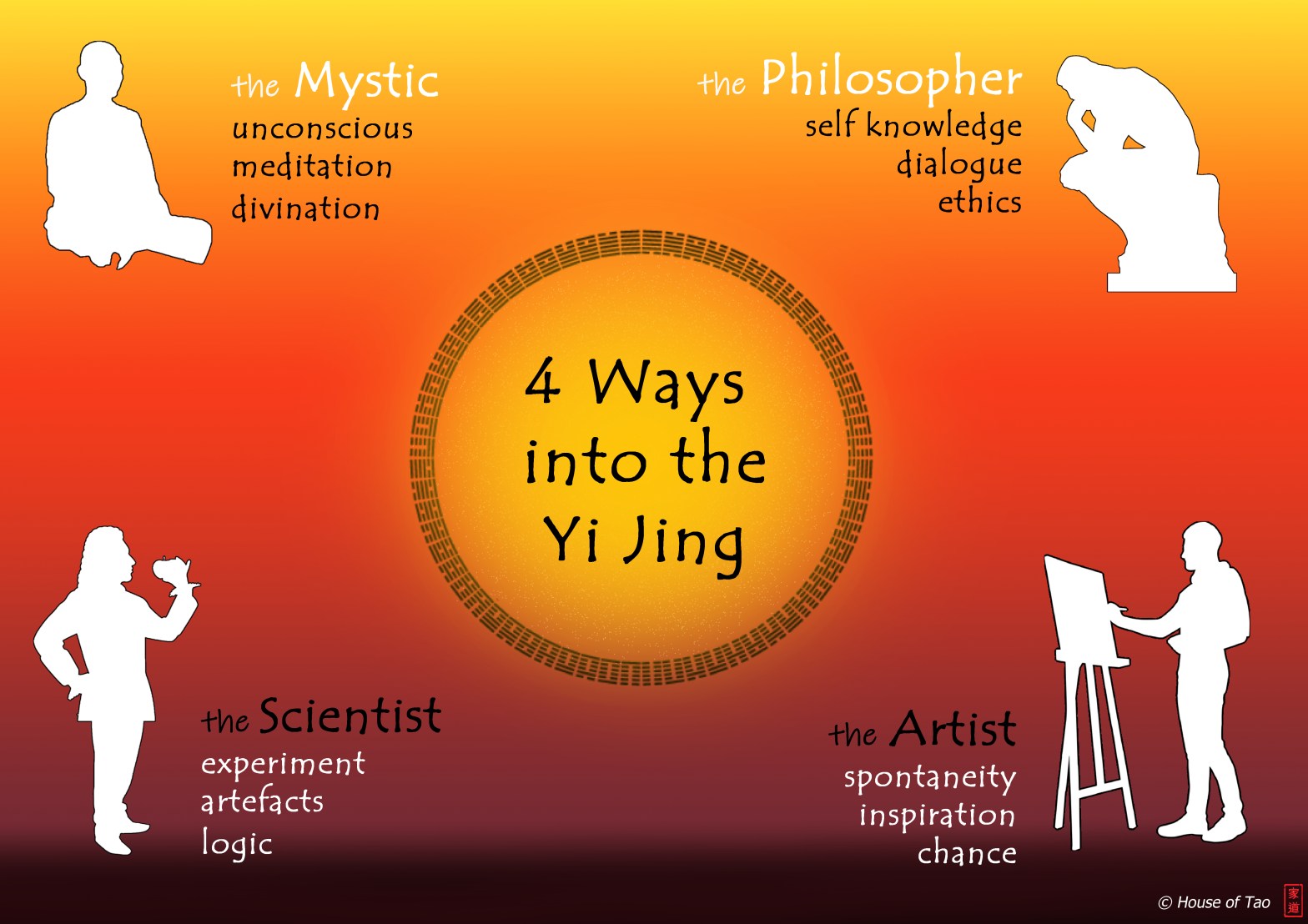
After the role of the philosopher, the artist and the scientist, it is time to approach the last role of our magic quartet but which is probably also the most elusive of the four: the mystic.
Where the philosopher seeks to develop his own living philosophy through a dialogue with the Yi Jing and uses his “digestive thinking” ability, the artist courageously leaps into the unknown (the void) to ignite spontaneous creativity and the scientist is challenged to question the mechanical paradigm that drives our world (view) and to reconnect with our ancestors by recording his experiments and re-living the past, we may wonder: What is left for the mystic to do?
Actually, this question already brings us to the essence of the mystic: he doesn’t have to do anything. At least, that is how it appears from the outside …
Some Keywords:
silence, hidden, secret, unconscious, inaccessible, meditation
Associated hexagram:
52 Keeping Still
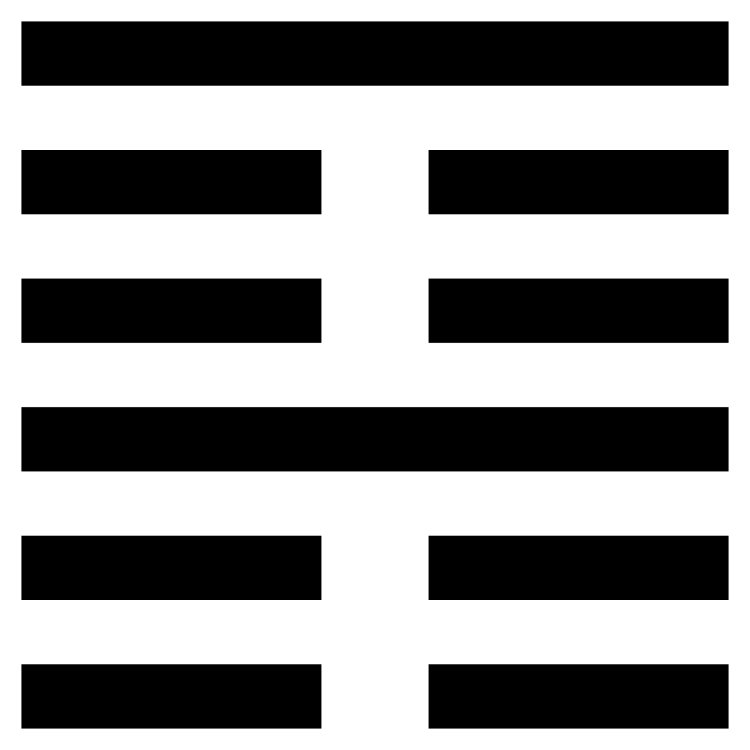
Keeping Still: Two mountains form a range
The associated hexagram I have chosen for this role has the image of a range of mountains. Traditionally, mountains have always been associated with stillness, the unchanging and transcending the mundane. It has often been seen as a connection point with Heaven, with esteemed gods and ancestors and as a gateway into the spiritual world. The hexagram can be translated as Keeping Still. The text of the image in the Wilhelm translation reads as following:
THE JUDGMENT
KEEPING STILL. Keeping his back still
So that he no longer feels his body.
He goes into his courtyard
And does not see his people.
Han Boering, a well-known Dutch Yi Jing expert, adds to his Yi Jing translation that the text implies that he is also not seen by the others.
THE IMAGE
Mountains standing close together:
The image of KEEPING STILL.
Thus the superior man
Does not permit his thoughts
To go beyond his situation.
This hexagram has probably been commented on the most throughout the centuries. It is associated with meditation, self mastery and enlightenment. Historical research shows that there were probably three main versions of the Yi Jing. We know that they each had their own arrangement of the hexagrams. Whereas the known Yi Jing starts with Tien (Heaven), one of the others started with Kun (Earth) and another one with Gen (Mountain) which is hexagram 52 in our Yi Jing.
Everyone knows how difficult it is to keep yourself still: our mind is almost always occupied with something whether we want it or not. In Chinese tradition, which owes a lot to Taoism (which could be way older than the official historical estimate), meditation is usually approached in quite a loose manner. Unlike with many yoga practices, one should just try to find a position in which one is able to be comfortable and relaxed. Whether you sit or lay down doesn’t really matter. We find this approach reflected in the Yi Jing. The lines of the hexagram uses body parts to represent the stages of keeping still and seeks to inspire the right way to keep yourself still without hurting either the body nor the mind.
The third line reads as following:
Keeping his hips still.
Making his sacrum stiff.
Dangerous. The heart suffocates.
One of the main themes of the Yi Jing has to do with the warning issued in this line. Every act should arise naturally and spontaneously in accordance with the time and the place. In this hexagram, one is advised to keep still and to wait for another time to take action. Generally speaking, when thinking of the purpose of meditation, the Yi Jing is advising strongly against using force to keep yourself still. This rigidity is a false form of stillness for which you will pay a price. The heart is strongly associated with the mind and is the seat of desires. Its element is fire and when it is suppressed, the fire will create smoke which suffocates your vital breath. Making the sacrum and hips still/stiff could also allude to abstaining from sexual activities which is often the case with people who dedicate their life to enlightenment. When this abstinence is enforced, spiritual growth is not possible and the heart will become polluted. Although everything may seem serene and good on the outside, the situation on the inside will be a breeding ground for darkness that will one day be out of control. The path of enlightenment is often also the quickest way into the abyss of darkness.
The fifth line reads:
Keeping his jaws still.
The words have order.
Remorse disappears.
The danger of talking too much is a recurring theme in the Yi Jing echoed in Confucianism, Taoism and Buddhism. Many things go wrong by saying to wrong words at the wrong time and the wrong place. Talking too much puts a barrier between yourself and others as well as the Unknown. Silence is in fact also an important practice to preserve your energy. The Mountain in the Yi Jing is associated with preserving and guarding energy. When we apply this hexagram and the role of the mystic with regard to the Yi Jing, it is important to realise that consulting the Yi Jing requires energy. Although focus on an important question is necessary, once it has been decided what to investigate, there should be a call for silence in order to turn inwardly. Without silence there can be no ritual, and without a ritual there can be no consultation that gives an enduring result. The mountains are the place where we meet the timeless realm of peace and calmness. In this meditative landscape, you can absorb the energy which is needed to be who you are meant to be.
What is the goal?
Each of the three other roles have a certain goal: produce philosophy, art or knowledge. The goal of the mystic, is in a deep sense, the very opposite which is to not have a goal. This is logically speaking also a goal, but this paradoxical tension is exactly what plays at the heart of mysticism. The mystic is able to enter the mountains of stillness simply by keeping still. The water of his inner world which are turbulent with emotions will become still by themselves. All action can only lead to more turbulence. By training the mind to apply non-action, a deeper layer in you can become active. As the water becomes quiet, the mud sinks down and clarity of heart can be reached. If the heart is not calm and clear enough, the answer of the Yi Jing will be difficult to receive. Therefore, the mystic is the foundation of the other three roles. Without the mystic, one becomes stuck in the surface of things without connecting to the source where one can replenish his energy.
But the mystic role is the most difficult role to embody in our time. Mysticism has become associated with superstition, illusions and tricks of the mind as the mechanical scientific dogma has taken over the leading role in the world. Although a growing number of people seek a connection with mysticism, for instance practicing all sorts of meditative methods, many also remain stuck in either a psychological approach to meditation or a fantasised world that is not rooted in reality but in ideology and desires.
What is mysticism?
Although mysticism does not let itself be analysed through mere words, it can be helpful to think about the origin of words in order to open up a more profound relationship with what the word was intended to point at. Think of words as the finger pointing at the moon … which is incidentally also a symbol for reflecting about matters that lie outside the visible realm of the day (normal consciousness).
The word “mystic“ comes from the word mystery. A mystery is something that lies beyond our comprehension, hence, of which we have no knowledge. Looking at the ancient Greek, the word is derived from mystēs, “one who has been initiated” and mystērion, which is a secret rite or doctrine consisting of purifications, offerings, processions, songs, etc. The root word is the verb myein, “to close, shut”. Perhaps meyin refers to keeping the lips closed (secrecy) or to the eyes (only initiates are allowed to participate and witness the sacred rites).
This original meaning of something which is closed reminds us of the judgement of the hexagram Ken discussed earlier: “He goes into his courtyard and does not see his people”. Such a person is turning inwards where eyes cannot follow. The courtyard is a metaphor for this personal inner world which we spontaneously visit in our dreams, but also when we actively use our imagination. Therefore, the essence of this hexagram could be pointing towards an attitude towards a situation, and to life in general, where we learn to step into our own inner courtyard in order to attain true peace which requires us to shut the door to the external world. The inner door only opens up when the outer door closes.
Re-enter your courtyard
In a world that is driven by the ideology of progress, a fish must swim upstream if he wants to reach this place of mysticism. Although the mechanical world view of progress has opened up new possibilities, and thus new doors for us, it has also been instrumental in shutting the doors that lead to inner peace. Without the necessary balance, energy is wasted and restlessness becomes the norm. In this restless world, it becomes every harder to find meaning in life. Ever since the industrial revolution and its ever growing influence, people have been encountering a feeling of meaninglessness at an alarming rate. The problem is that in the ideology of progress, the only goal left to do is not only to unveil all mystery but also to make it useful. It neglects the importance to have an encounter with the mystery itself as a meaningful and necessary component of life. By looking at everything through the glasses of usefulness, a mirror image is reflected back at us that suggests that perhaps we ourselves are not that useful.
I believe the Yi Jing can help to bring back balance in this dire situation where we have become prey of our own self-defeating ideology. The confrontation with the unknown which happens during an Yi Jing consultation is a remedy. I think it is exactly this what also brings people of the modern age to consult the Yi Jing instead of consulting, yet again, Google or now a days ChatGDP. The Yi Jing gives the opportunity to re-open this door to the inner courtyard in a straightforward way. Anyone can do it! “Yi” does not only mean change but also easy …
Countless books have been written about how intangible yet real the mystery of the Unknown. I find great meaning in how the Tao Te Ching (or Daodejing) approaches the subject.
In verse 21 it is said:
The greatest virtue you can have
comes from following only the Tao;
which takes a form that is intangible and evasive.
Even though the Tao is intangible and evasive,
we are able to know it exists.
Intangible and evasive, yet it has a manifestation.
Secluded and dark, yet there is a vitality within it.
Its vitality is very genuine.
Within it we can find order.
Since the beginning of time, the Tao has always existed.
It is beyond existing and not existing.
How do I know where creation comes from?
I look inside myself and see it.
Tao Te Ching. 1996, transl. J.H. McDonald
As we can see, Lao Tse follows the philosophy of the Yi Jing and urges one to look inside in order to attain a different order of knowing – knowledge about the foundations of life itself. This form of knowing appears as irrational to our modern intellect which prefers to reject it out of hand as “useless daydreams”.
As I have discussed in my post about the role of the scientist, in order to develop a sound rationality one also needs a meaningful encounter with the irrational. When we do not allow anything of importance to exist outside our circle of control, we more easily become hypocritical and arrogant in our ways. In the end, what we suppress will grow out of control and resurfaces in all sorts of irrational behaviour that will be rationalised a-way. Paradoxically, we will gain more mastery of ourselves when we accept that our potential for control is very limited. Therefore, mastery of the self will not come from the will to control but from accepting the inner truths that live in us, and these can only be encountered on the path of the mystic …
 Master Your Energy
Thank you for this. I just wanted to say that I very much appreciate you clear and open writing style. It can be difficult to get a hold on topics which dip into the indescribable, but you have presented them in a wonderful set of connected contexts here.
LikeLike