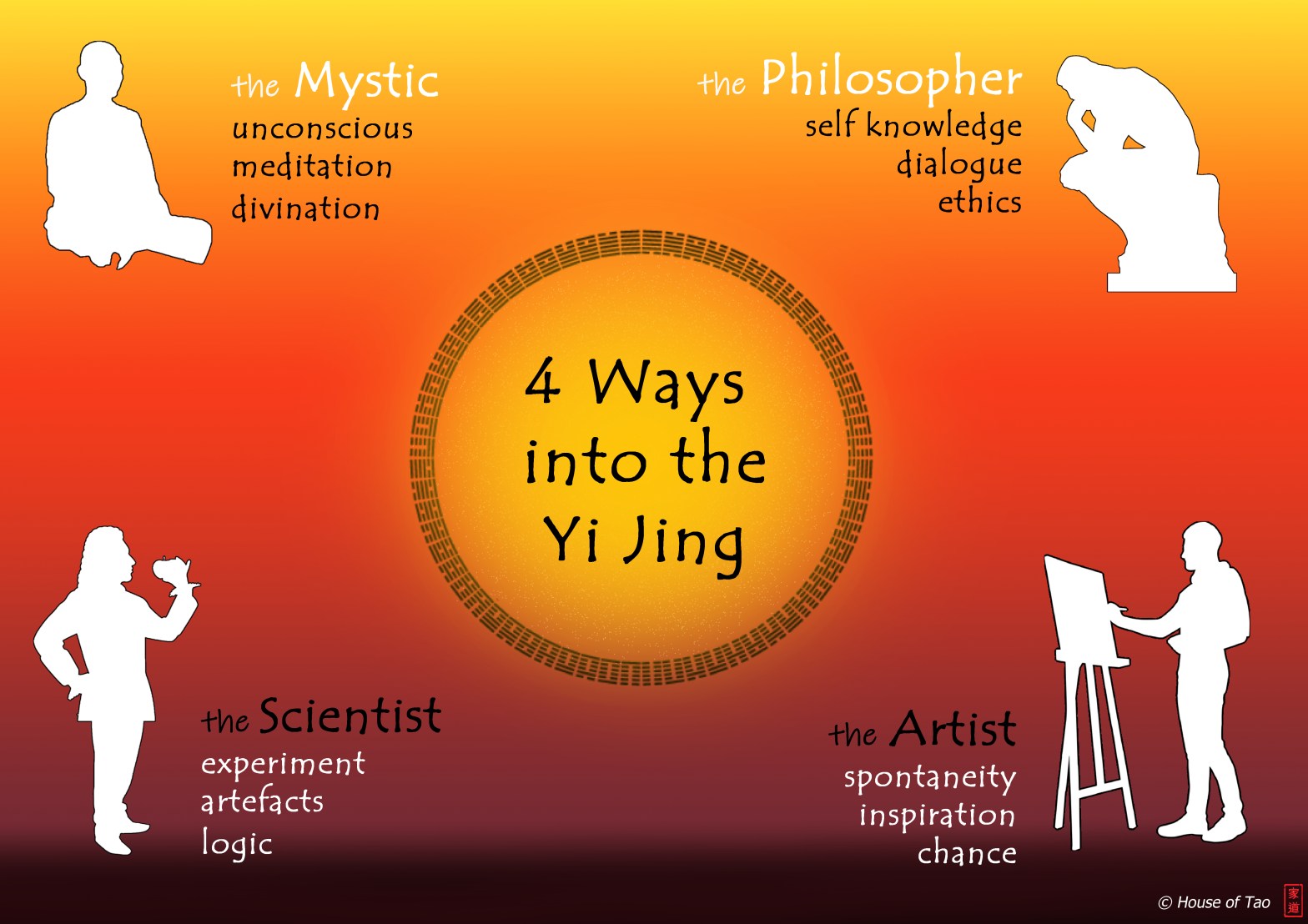
This is the third post of our series concerning the Four ways in which one could use the Yi Jing. This approach is offered as an aid that could help you to expand your study of the Book of Changes. It can also help you to become more aware of how you are already using it.
In the first post, we talked about the role of the Philosopher and the nature of Thinking: how the Yi Jing can help us to develop a more profound and holistic thinking that involves the larger Mind. Furthermore, we used hexagram 21 Nourishing to illustrate Thinking as a form of digesting. In the second post, we put our focus on the role of the Artist where we emphasized the fearlessness that is needed to go beyond the control of the Mind in order to reach Wu – the Void. The creativity and passion of the Artist is first aimed at this emptiness, and it is through this process of detachment that the Artist can produce something spontaneous and give it form in this world. We associated the Artist with hexagram 25 Innocence because here we can find the configuration that is needed to connect with Heaven and receive the impulses to work without planning the end result.
In this third post, we will approach the possibilities that the role of the Scientist could open up for us. Are you ready?

Some Keywords:
experiment, open mind, research, senses, simplify, document, uncertainty, limits
Associated hexagram:
34 The Power of the Great

All the domains that cover what we today call “science” are enormous in scope, and thus impossible to discuss in this short article. But instead of loosing ourselves in this vast amount of research fields and data, I first want to focus our attention to the danger that a certain kind of science presents to us at this moment in time and how this is reflected upon in the Yi Jing. That kind of science is the mechanical ideology that permeates most fields with physics viewed as the basis of all other sciences. In short, it is a view that all phenomenon in life, from matter to mind, cosmos tot plants, can all be understood and described in mechanical terms. Anything, no matter how complex, is nothing more than a system of mechanically interacting parts. It is no wonder that in this view, everything is reduced to a machine, from the universe to the human body.
This mechanical ideology has ignited a whole chain of new experiments and the development of machines that have made our modern globalized world possible, including the computer on which I am typing this text. This shows us the great power this approach holds. But, there is a price to pay with all this “progress”: the natural environment is destroyed and sacrificed to built all these machines, devices and gigantic concrete structures. Furthermore, human beings become more isolated from one another as the stability of the social fabric is disturbed by all the rapid paced changes that new technological innovations provoke incessantly. The mechanical ideology brings mechanical progress, but it does not offer a frame in which to give meaning to life. Everything is thought to be “accidental” with no underlying principles that would have lead to our very own existence.
Because we were born in the world mainly dictated by the mechanical paradigm of science, this dominating view on life has conditioned our thinking and holds some of our deepest convictions of how reality “works”. Therefore, it will also be the most difficult role to reflect on. The relevance of this exercise is huge because our world view, which is usually active unconsciously, determines how we give meaning to things. It also decides what we perceive to be possible and what not, what we value and what not.
For those who know hexagram 34, The Power of the Great, it will already be clear that I chose this hexagram because science holds the promise of a great power and that this in itself is also the great danger it carries within. The image is that of Thunder above Heaven: a powerful motion has already gone and grown beyond the Middle. Therefore, the Yi Jing advises to use this power carefully and to act in accordance with natural law in order not to bring about disasters. The Image thus reads:
THE IMAGE
Thunder in heaven above:
The image of THE POWER OF THE GREAT.
Thus the superior man does not tread upon paths
That do not accord with established order.
In the third line, it says:
The inferior man works through power.
The superior man does not act thus.
To continue is dangerous.
A goat butts against a hedge
And gets its horns entangled.
Numerous philosophical works have been written about power and its problems, but as it stands today, we live in the midst of a globalized power which has been centralized in the hands of the few. This is a very dangerous situation which can also be demonstrated by the fact that liberties and rights worldwide have been trimmed down severely and that democracies are well on their way to become totalitarian regimes that control every aspect of life through technological and social surveillance. In this line, one is cautioned not go further because one will cross the line of the middle and start using excess power. The goat (incidentally the symbol for Satan in Christian religion) is stubborn and thunders ahead with its horns ready to destroy any obstacle in its way. What is the result? It entangles itself in a hedge which is strong and flexible at the same time. The goat entangles itself in it and the harder it butts, the worse it becomes. This is exactly what happens with the global problems of social unrest, health problems and environmental destruction that the excesses of the mechanical ideology have entangled us in: instead of reflecting and adjusting, we are adding even more mechanical systems that entangle us even further in them.
I see an opportunity to use the study of the Yi Jing to become better aware of this mechanistic world view and how it limits our field of thinking and investigation. If we can attain a more pure essence of science – involving uncomfortable exercises in uncertainty, limits and open mindedness – we might also enrich and broaden our study of the Yi Jing itself in ways unexpected! As I see it, this is one of the central aspects of using the Yi Jing as a scientist.
Let us look further into what a scientific role can bring us when it is not fully entangled in this mechanical paradigm.
Your Living Documentation
The easiest connection point with science is something most Yi Jing users will do: they keep some kind of journal in which they note their questions and the answers the Yi Jing has given. This is an old tradition that can archaeologically be traced back to the Shang dynasty (app. 1600 BC). Here we can find the questions and answers engraved in bones belong to animals such as turtles and oxes (“dragon bones”). These inscriptions are the oldest known to date and show us a part of the evolution and changes in ancient Chinese. In other words: by documenting your Yi Jing consultations, you are partaking in one of the oldest known traditions which is even linked to the development of writing itself!

Although documentation does not necessarily lead to science, it is an essential feature. By documenting your conversations with the Yi Jing, you can study patterns, correlations, images and re-investigate questions and problems helping you to gain a broader understanding and possibly arriving at new questions and insights. Your journal does not have to be limited to Yi Jing consultations: you can use it to document other investigations of the unconscious mind such as dreams, visions and inspirations. It can also be your study book to take notes from interesting books and other sources.
The Anthropological Researcher
For those who, for whatever reason, do not wish to use the Yi Jing through divination methods, I would recommend to try the anthropological method: try to imagine how ancient people would have consulted the Yi Jing by following in their footsteps as close as you can. This is the only way to obtain a living experience of our past. If we do not take the world view of our ancestors serious, why would we study them at all? If we do not take the step to experience these older world views, how can we claim to understand anything at all about them? Will we describe the qualities of water without drinking it? Without diving into it? This is the dilemma our contemporary science has to deal with in a more satisfactory manner in order to overcome the crisis it is currently in. Science should be a method to help humanity connect with its own past in a respectful and meaningful way, and it has been lacking in this for a long time.
Not only has the Yi Jing been used for centuries to seek council through methods of divination, whether with coins, sticks, turtle shells or other, the Yi Jing itself contains direct answers and indications that it is at least partially designed for this.
In hexagram 4, Youthful Folly, the Judgement of the Yi Jing reads:
YOUTHFUL FOLLY has success.
It is not I who seek the young fool;
The young fool seeks me.
At the first oracle I inform him.
If he asks two or three times, it is importunity.
If he importunes, I give him no information.
Perseverance furthers.
The image is that of a Mountain which can symbolize a person of authority (such as a wise person, the Yi Jing, a parent, etc.) and the Water flowing from and below it the danger of moving forward without foresight. In the lines, we find both warnings towards the figure of authority: when he should discipline nor that disciplining itself should be too harsh (line 1). Furthermore, he should also learn to tolerate the folly of others (Line 2) and if punishment cannot be avoided it must be done with good measure (Line 6). Warnings aimed at the ignorant person (which all of us are at some point or some level) warn against loosing yourself in your own illusions (Line 4) and loosing your individuality to another strong person (Line 3).

The situation is all too human: one has consulted the Yi Jing for advice, but for some reason the answer was not accepted by the inquirer who decided to consult again, asking the same question (perhaps formulated differently). The text says that when this happens, the oracle will no longer give advice. In other words, the answers obtained will become nonsensical. There is a psychological truth to this: if you just want to receive a confirmation, you may have the same result when you ask another person for advice. In fact, you are not really asking for advice and those who designed the Yi Jing incorporated the psychological trap of this attitude. Asking a question is not a given: asking is a state of consciousness. One has to learn to become better aware whether one is asking an open question or not. Besides asking for a confirmation, you can also be asking for reassurance. This last possibility is not a problem in itself: a good use of the Yi Jing has a strengthening effect on the mind, diminishing the need for reassurance when faced with problems. Also, the basic philosophy of the Yi Jing is optimistic and aimed at interconnectivity which also has a reassuring effect on the heart.
Our human traits are not different from those of our ancestors. To seek confirmation in our fears and hopes is not inherent in divination or the Yi Jing: it is human nature. Whether one falls in this trap through divination or another means, such as science, media or religious beliefs, the trap is the same.

Thinking within the Yin Yang philosophy, we can also understand the need to engage consciously in irrational activities. If conscious thinking and acts are Yang, then allowing something outside our field of control to play a role of significance is Yin. If we suppress Yin, it will take its toll on our health and our Yang energy will become corrupt. Indeed, in our Western society which excludes irrationality from anything meaningful, the quality of rationality has become deplorable. Therefore, meaningful irrationality is a gateway to true rationality.
Logic, Mathematics and beyond
One field that has received more and more attention is the mathematical and logical theory underlying the organisation of the hexagrams of the Yi Jing. The binary principle of representing all phenomena with open and closed lines is the same logic that underlies our own computer systems. There is a fascinating history surrounding the binary of mathematics developed by Leibniz who was the first scholar who took Chinese philosophy seriously and even learnt Chinese in order to study it. Upon seeing an ancient document with a certain arrangement of the hexagrams, Leibniz realised the parallels with his own binary mathematics. He was amazed to see such an ancient text containing the same mathematical structure as his own new binary mathematics. His first paper from 1703 about his binary mathematics, which by the way all our computers use, was titled:
An Explanation of Binary Arithmetic using only the Characters 0 and 1, with Remarks about its Utility and the Meaning it Gives to the Ancient Chinese Figures of Fuxi.
And Leibniz was not the first nor the last intellectual who would investigate the mathematics of the Yi Jing.
Another interesting field worth mentioning, is molecular biology. Apparently, the structure of the Yi Jing hexagrams has a lot in common with the genetic structure. Some researchers are using the Yi Jing to develop different mathematical approaches into their own field:
Perhaps the most spectacular is its association with molecular biology and the genetic code. The two systems share a basic principle of using a quaternary system of numbers: four bases in DNA and RNA, and four diagrams of the I Ching. Both systems have 64 combinations: triple-base genetic codons and hexagrams for the I Ching.
Yan, J.F. (1995). Biomathematics Derived from the I Ching. Advances in Human Factors\/ergonomics, 20, 1059.
We have only skimmed the surface of how the Yi Jing is itself relevant for modern science. We find more and more papers in different fields of science that discuss the Yi Jing and its relevance to their own field, whether it be communications science or molecular biology. Thus, the Yi Jing is at once an object of study (mostly within the cultural and linguistic sciences) and a source for inspiration to investigate new ways of thinking and computing.
The Adaptable Chameleon
To summarize, the scientific role of the Yi Jing is very multi-faceted and very dependant on your own background. But even without a scientific training, you can establish a scientific role in your studies of the Yi Jing by (1) using it to become more aware of your (often) unconscious mechanical world view, (2) document your investigations thoroughly and (3) adopt an anthropological perspective to connect with ancient traditions and people. In essence, the Yi Jing can help to integrate ways of thinking and connecting that we have deemed worthless in a meaningful way. Whatever direction you take, the Yi Jing will be able to adapt itself to your unique road as it has always done throughout its thousands of years of existence. Not coincidentally, the character Yi apart from meaning “easy” and “change”, is also thought to have had the meaning of a chameleon …
Let me know how you use the Yi Jing from a scientific perspective!
 Master Your Energy
Eén opmerking over 'Four Ways into the Yi Jing: the Scientist (3)'