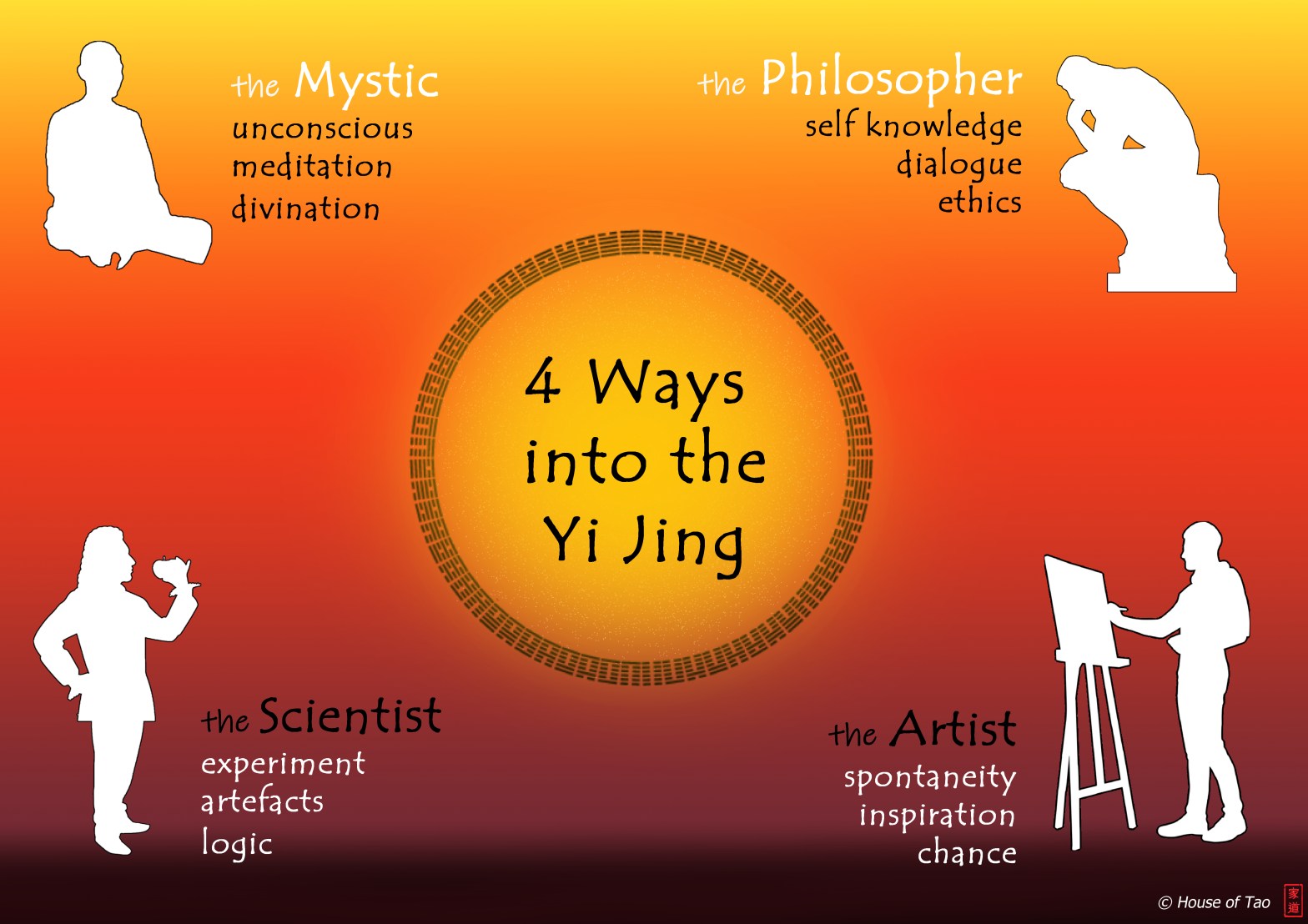
Much ink has been used to approach this mysterious book called “Yi Jing” or the Book of Changes. In this series of posts, I would like to advance the idea that we can “get into it” in four different ways that are quite different and yet complementary to one another. Although this might seem material for a more advanced user of the Yi Jing, this is certainly not the case. The ideas put forward in this article are certainly of use to the beginner as well for they can help to identify which type of role one is naturally inclined to and which not.
The Archetypal number Four
The number four is a number that pops up in a lot of categorizations of fundamental properties. So perhaps these four ways into the Yi Jing are also part of the archetypal power of the number four. We can think of the four elements: air, water, fire and earth. Or we can imagine them as being the four winds of ancient mythology that blow their own character from the four corners of the world. I am also reminded of the four cognitive functions according to Carl Jung: thinking, feeling, sensing and intuition.
Let us explore these four ways and four roles that we can take on in order to have a richer, more meaningful and less rigid relationship with the Yi Jing. I will also associate each role with a certain hexagram, which is also an opportunity to explore some of the meanings of these symbols from the Yi Jing.
1. The Philosopher
Some Keywords:
self-knowlege, dialogue, ethics, original thinking, life philosophy, carefulness, language
Associated Hexagram:
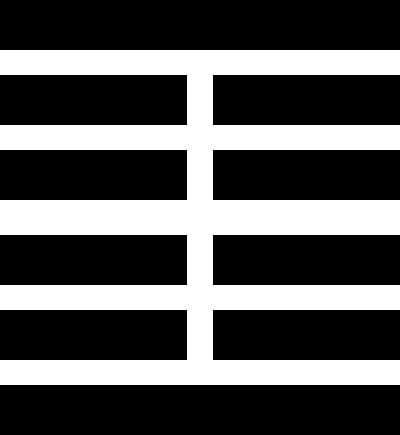
27 Nourishment (corners of the mouth)
Philosophy is usually associated with Thinking. But what is thinking and how can we think with the Yi Jing?
A Challenge to our Thinking
If we look at ancient philosophy from the East, they would have a different idea of “thinking” compared to philosophers in the Western tradition. That is because they have a different idea of what the real mind is. For them, the intellect is not the most important source of thinking. In this holistic vision, we should think more from the Heart … but here too, we understand this word and concept differently. So, how do we begin to built a bridge and learn a different form of thinking? Practicing with the Yi Jing is a good way to go beyond theoretical exposition and train your deeper mind.
But the Yi Jing is a real challenge to anyone’s thinking: it has elements of divination and wisdom, it has logic and feeling, it has myth and fact. To think with the Yi Jing (not against) is to think Yin and Yang, not Yin or Yang. This never ending dialogue between the two poles is what requires the thinker to remain flexible and determined at once. In other words, the Yi Jing challenges us to think with more than our brain, with more than our intellect. It wants us to think in a deeper, more holistic and natural way.
The Easy Philosophy
The Yi Jing is an open ended philosophy that does not help our thinking to reach a final point of rest. It talks about probabilities which contain uncertainties and certainties. This makes it stand in contrast with much of Western philosophies. The complexity of life is not reduced to simpler components like we are used to do. And yet, one of the meanings of “Yi” is simple or easy.
One could say that reducing the complexity of life is a short term strategy that creates chaos and unsolvable problems in the long term. In the Yi nothing is reduced into something else. The symbols and language are not meant to replace anything: they act like a gate that leads towards the things themselves. Therefore, the Yi will train our mind into allowing true complexity and understanding the limits of reduction.
A Coach to develop your Life Philosophy
As a philosopher, one cannot remain content by consulting the Yi Jing and reflect on the answer. Behind the book of the Yi Jing stands a living metaphysical world view: it contains a cosmology of how reality is ordered, how change comes about and how we can live in it. Yi Jing consultations are a method to become the embodiment of the principles that are contained within the hexagrams.
But the Yi Jing does more than that: it inspires us to create a living philosophy of life. It is like music that inspires other music. The way it is conceived, it leaves enough emptiness and openess in order for an individual to find his own expression. Instead of narrowing our possibilities down, it opens up hidden doors and pathways that allows a person to grow.
Thinking as Nourishment
Let us go back to our first question: what is thinking?
In the Yi Jing, we can penetrate an important meaning of thinking with hexagram 27 which concerns the Nourishment of ourselves, and how we nourish others. The lower trigram is Thunder (Chen) which represents the lower jaw which moves upwards. The upper trigram is Mountain (Ken) which is the upper jaw that does not move. The combination of motion and rest produce the act of eating, as well as speaking. Therefore, nourishment is part of the same cycle as speaking: food goes in, words come out. But what has this to do with thinking?
The Judgement (the overall idea) of the hexagram reads as (trans. Wilhelm):
THE CORNERS OF THE MOUTH.
Perseverance brings good fortune.
Pay heed to the providing of nourishment
And to what a man seeks
To fill his own mouth with.
If we regard thinking as a form of eating, it will come as no surprise that people have said “you are (or think) what you eat”. Indeed, to a certain amount we physically are what we eat. When we eat unhealthy food, it will be more difficult to remain healthy. But the same applies to all other things that we absorb in us. Thinik of words, images, sounds, ideas and even thoughts of others. These too will have to be “digested” in some way. And this process of digestion can be seen as the process of thinking: breaking things apart and analyzing their value, retaining the valuable and discarding the rubbish, and possibly synthesizing a new thought.
The question is: will what we regularly nourish ourselves with make us healthy or not? Because, whatever we take in, we will have to do something with it, and it will always have its effect on our being. Therefore, the Yi Jing warns us not to eat just anything because it will determine the quality of our life, our thoughts, and our words.
The hexagram of Nourishing suggests the process of digesting: the upper and lower line are firm, whilst all the inner lines are open. This reminds us of the trigram of Fire (Li). In Nourishing, the multiple Yin lines enclosed by two Yang lines suggest a slow kind of burning, such as the process of digestion which takes time.

The first three lines of this hexagram describe different kinds of malnourishment and its problems:
1. You let your magic tortoise go,
And look at me with the corners of your mouth drooping.
Misfortune.
The magic turtle is said to live from air alone. In this situation, you reject (or undervalue) the importance of the kind of nourishment which has to do with the spirit: your natural ability to nourish yourself on imagination, which is vital for your well-being, becomes obstructed.
In terms of thinking, one could imagine a kind of materialistic philosophy that gives no or little value to imagination, consciousness and the psyche. This is the kind of philosophy that has been dominating our scientific institutes and schools.
The line can also be associated with Qi Gong practices of breathing. In Qi Gong, breathing is thought to be our primary nourishment of energy (instead of food). Therefore, proper breathing is fundamental to our well being. The tortoise is used as an example of how to breath properly and there are numerous tortoise excercises to train the ability to nourish oneself through breathing.
2. Turning to the summit for nourishment,
Deviating from the path
To seek nourishment from the hill.
Continuing to do this brings misfortune.
In this line, one is seeking nourishment at the wrong place or the wrong source. The path leads “up”, probably because one is lead to believe that “up” there is the “good food”. A higher place also recalls a higher position or what is perceivd as “success”.
In terms of thinking, this could be seen as the kind of thinking that leads to overly abstract constructions that are barely connected to anything physical or even emotional. These kinds of “rational” thoughts that claim themselves to consist of “pure logic”, are in fact dominant elements that cut you off from other nutritious thoughts because they are deemed “too low”.
3. Turning away from nourishment.
Perseverance brings misfortune.
Do not act thus for ten years.
This line is clear: for some reason or other, you are rejecting real nourishment. In terms of thinking, one could imagine a conversation between two people where the other dismisses an idea out of hand without giving it a single thought. There are many reasons why we could refuse some kind of nourishment: we are caught in a certain ideology, we are afraid of a different view or we think we have all the nourishment we need.
Using the Yi Jing is a perfect tool to become conscious of blockages and to achieve a more original and pure form of thinking. Not only can it help us to turn off the automatic pilot of the mind, it can also help us to access the larger or deeper Mind in us which is more than our intellect. The ancients point at our Heart when it comes to true thinking, and not the head.
Considering what psychology of the unconscious has learnt us, this is certainly true. More than often, our intellect is just reacting to deeper emotional issues in ourselves. Instead of facing these and resolving them, the intellect is easily tempted to seek the shortest path to relieve this pain through ideologies and fixed thoughts. These are then defended vehemently and will make it difficult to digest other forms of thinking.
Philosophy and Divination
Does a philosopher use the divination methods of the Yi Jing? As I have written elsewhere, one of the most important components of the Yi Jing is active engagement with its philosophy. Asking a question and studying the hexagram that came up “randomly” through divination, is a way to bring the meaning of the symbolisms into one’s own life. Through this method, the philosophy becomes a personal matter that gives us a chance to make our involvement with it much deeper, more authentic and complete.
If someone wants to become a carpenter, we would naturally expect such a person to follow practical courses next to theoretical expositions. It is by doing carpentry that someone becomes a carpenter. Training your mind with the Yi Jing requires the involvement of random chance: this is the needed block of wood, or the obstacle that pushes back, with which we get to work. It is by letting go of total control that we can learn how to walk the path of self mastery. Reading the Yi Jing without divination is not only incomplete: it ignores the purpose of the Yi itself.
What are your thoughts on the four roles of the Yi Jing? Tell us in the comments!
In the next post, we will take a look at the role of the Artist.
 Master Your Energy
Eén opmerking over 'Four Ways into the Yi Jing: The Philosopher (1)'